
Content Marketing That Converts
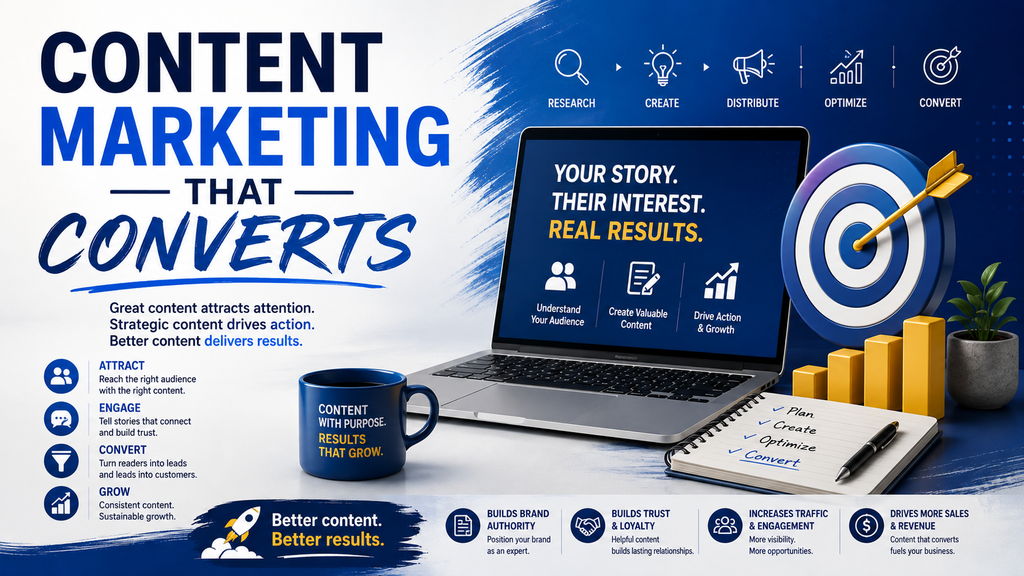
Publishing content is easy. Publishing content that actually turns readers into customers is a different challenge entirely. Most businesses have no shortage of blog posts, social updates, or videos floating around online. What they’re missing is content that does more than get views, content built to move people toward a decision.
This post breaks down what separates content that simply exists from content that converts, and how you can start building a strategy that turns your marketing efforts into real, measurable business results.
Why So Much Content Marketing Fails to Convert
Plenty of businesses treat content marketing as a numbers game. Post often enough, cover enough topics, and eventually something will land. The problem is that volume without direction rarely produces results. Content that isn’t built around a clear purpose tends to attract passive readers who consume it and move on, never taking any further action.
Converting content works differently. It’s created with a specific outcome in mind, whether that’s a purchase, a signup, a booked call, or a download. Every piece serves a role in guiding someone from curiosity to commitment.
What Makes Content Marketing Actually Convert
It Starts With a Real Understanding of the Audience
Content that converts is built around what your audience genuinely struggles with, not what feels easy or interesting to write about. This means going beyond surface level assumptions and digging into the specific questions, objections, and pain points your ideal customers actually have. The closer your content maps to a real problem someone is trying to solve, the more likely they are to trust your solution.
It Has a Clear Purpose
Before writing a single word, effective content marketers ask a simple question: what should the reader do after this? A blog post might exist to build early awareness, while a case study might exist to remove hesitation right before a purchase decision. Content without a defined role in the customer journey tends to wander, and readers can feel it.
It Builds Trust Before It Asks for Anything
People rarely buy from brands they don’t trust. Converting content earns that trust first by delivering genuine value, honest insight, or a new way of thinking about a familiar problem. Only after that value has been delivered does it make sense to introduce an offer or next step. Content that leads with a hard sell before establishing credibility tends to push readers away instead of pulling them in.
It Speaks to a Specific Stage of the Buyer’s Journey
Not every reader is ready to buy the moment they land on your content. Some are just becoming aware of a problem, others are actively comparing solutions, and some are close to making a final decision. Content that converts is mapped to these stages:
- Early stage content educates and builds awareness around a problem
- Middle stage content compares options and builds confidence in your approach
- Late stage content removes final doubts and makes the next step obvious
Trying to force a hard sell into early stage content, or over explaining basics in late stage content, usually backfires.
It Includes a Clear, Natural Next Step
Every piece of content should end somewhere. A strong call to action doesn’t have to feel pushy. It simply needs to be clear about what to do next, whether that’s reading a related article, signing up for a newsletter, or requesting a demo. Content without any next step leaves readers with nowhere to go, and most won’t go looking for one themselves.
It’s Backed by Proof
Claims alone rarely convince anyone. Converting content backs up what it says with real evidence, whether that’s data, testimonials, case studies, or before and after results. Proof turns a claim into something believable, and believable content is far more likely to lead to action.
Formats That Tend to Convert Well
While almost any content format can be built to convert, a few consistently perform well when done right:
- Case studies that walk through a real customer’s problem and outcome
- Comparison guides that help prospects evaluate their options with confidence
- In depth how to guides that demonstrate expertise while solving a real problem
- Customer testimonials and reviews woven directly into relevant pages
- Product focused blog posts that connect a common problem directly to your solution
Common Mistakes That Quietly Kill Conversions
Even well written content can underperform if it falls into a few common traps:
- Writing for search engines instead of real people, resulting in content that reads unnaturally
- Burying the value deep in the piece instead of leading with it
- Failing to include any clear next step for the reader
- Focusing entirely on features instead of the outcomes those features actually deliver
- Ignoring where the content fits in the broader customer journey
Measuring Whether Your Content Is Actually Converting
Traffic and page views tell you people are showing up, but they don’t tell you whether your content is working. To understand real performance, track metrics tied directly to action, such as form submissions, click through rates on calls to action, time spent on key pages, and how much revenue or leads a specific piece of content contributes over time.
Reviewing this data regularly allows you to identify which content is genuinely driving results and which simply needs a rework or retirement.
Final Thoughts
Content marketing that converts isn’t about producing more. It’s about producing with intention. When every piece of content is built around a clear purpose, a real understanding of your audience, and a natural next step, it stops being noise and starts becoming a genuine driver of business growth.
If your current content isn’t converting the way you’d like, start by reviewing your best performing pieces and asking what made them work. Chances are, the answer comes down to clarity, trust, and a next step that made sense.